
LAKE MANAGEMENT TREATMENT COMMITTEE
CHAIR | BRENT SCHNELL
The Long Lake Association treats the invasive species Eurasian Watermilfoil (EWM) since it spreads quickly and proliferates, crowding out native plants and provides a lower quality habitat than the native plants for fish. It can also create dense mats near the water surface that entangle boat propellers and make it difficult to swim or fish. LLA currently uses a combination of ProcellaCOR and 2,4-D to treat EWM. In 2025, 4 acres were treated in June (1 acre with ProcellaCOR and 3 acres with 2,4-D), and 7 acres were treated in July with 2,4-D (11 acres total). Therefore, LLA treated a total of 11 acres for Eurasian Watermilfoil (EWM) in 2025. This represents treating less than 0.4% of the total area of Long and Mickey Lakes combined. Although it is virtually impossible to totally eradicate Eurasian Watermilfoil (EWM, we are now in maintenance mode and have EWM under good control in our lakes at this point in time based on our continuous surveillance and treatment program. If you receive an EWM treatment permission letter, please sign and return it so we can continue to control EWM in our lakes.
The Lake Management-Treatment Committee and our key lake management partners met on April 1, 2026. Clear Water Lake Management (our herbicide applicator) and Zero Gravity (aerial drone guidance) were at the meeting to help us review the 2025 results and plan for 2026. The 2026 treatment plan will include a combination of ProcellaCOR and 2,4-D. We plan to continue treating the aquatic invasive species Eurasian Watermilfoil (EWM) twice this year, as usual, to improve lake quality for boating, etc., using drone-based aerial guidance to precisely target treatment where EWM is present. We only treat where EWM is found on treatment days. The 2026 plan is to treat approximately the same total area as in 2025 (e.g., 11 acres). The areas treated with ProcellaCOR in 2025 were especially successful. Many of the sites that previously contained the aquatic invasive species Eurasian Watermilfoil (EWM) are growing native plants now that the Eurasian Watermilfoil is gone. Some areas were successfully treated in past years, but Eurasian Watermilfoil has now returned, requiring treatment in 2025. Treatment dates for 2026 are Tuesday, June 23, 2026, and Tuesday, July 28, 2026.
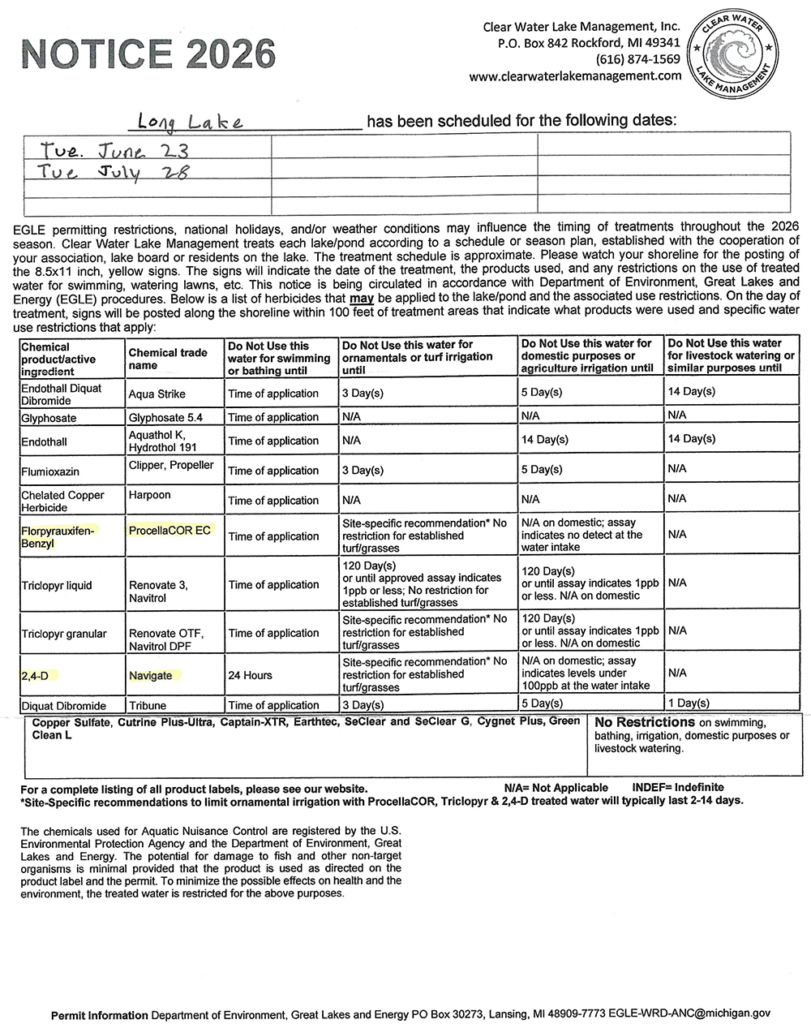
The Long Lake Association (LLA) continuously evaluates new potential treatments to best control Eurasian Watermilfoil (EWM) while minimizing impacts on the lakes and the people who use them. Based on this objective, the LLA will increase the use of ProcellaCOR EC in Long and Mickey Lakes in June 2024 to control EWM, given the very positive results thus far.
ProcellaCOR EC is a new, state-of-the-art treatment for invasive aquatic plant species like Eurasian Watermilfoil (EWM) with the benefits listed below:
- ProcellaCOR EC is selective. It targets explicitly Eurasian Watermilfoil (EWM) and other invasive aquatic plant species, and it won’t hurt the native plants we want in the lakes.
- ProcellaCOR EC reduces chemical usage through more extended control. Less product is required for treatment because ProcellaCOR EC has a unique formula that uses 40x-100x less active ingredient while still achieving significantly longer control. A “Reduced Risk” classification from the EPA is designed to reduce risk to our health, non-target plants, and water supply. The EPA says ProcellaCOR EC is “practically non-toxic” to animals and humans.
- Since ProcellaCOR EC will keep EWM at bay for much longer than other solutions, it reduces the need for two treatments per year, as is typically required with other treatment options.
- ProcellaCOR EC has a short half-life (the time it takes for half of the active ingredient to degrade) of only 6 hours and quickly dissipates in the water column. Typically, ProcellaCOR EC is not expected to be detectable in the water within 24 hours of treatment.
It should be noted that ProcellaCOR is cost-effective in shallow-water applications but becomes prohibitively expensive in deeper-water applications. Therefore, the LLA intends to focus its efforts on developing the best possible hybrid approach to EWM treatment, including other solutions such as benthic barriers.
INVASIVE SPECIES FUNDING
The activities of the Lake Management Committee on all three lakes are funded by the Long Lake Association and our local partners. Thank you to Charter Township of Long Lake for supporting the drone guidance and EWM mapping efforts. Your LLA membership dues are an essential part of our funding to control the levels of Eurasian Watermilfoil (EWM) to protect our lake from this very aggressive aquatic invasive species. If you wish to provide further financial support for this program, the Long Lake Foundation (LLF) has created the “LLF Invasive Species Defense Fund” to fund further study and investigate remediation techniques of both aquatic and terrestrial invasive species in and around Long, Mickey, and Ruth Lakes. Your tax-deductible donation under the 501c3 designation of the IRS code to this critical fund will ensure our lakes’ effective management and health far into the future. Please visit the LLF website at www.longlakefoundation.org to learn about the Long Lake Foundation and donate online or mail a check to “Long Lake Foundation” to P. O. Box 31; Interlochen, MI 49643 and put “LLF Invasive Species Defense Fund” in the memo area.
NATURALLY OCCURRING BIO-FOAM
REFERENCE MATERIALS
Bio Foam | An Naturally Occurring Phenomenon | DEQ | Download File
Aquatic Plant Control | Things to Consider | Tony Groves & Pam Tyning | Download File